

How to Measure Trailer Leaf Springs — and Know What Else Needs Replacing
Measure free length, width, leaf count and spring style correctly, then inspect shackles, equalizers, bushings, hangers and U-bolts before ordering a replacement spring.

A trailer leaf spring can look “close enough” and still be the wrong replacement.
Correct fitment depends on more than axle capacity. You need to identify the spring style, free length, width, leaf count, capacity, eye/bushing size, and the suspension hardware around it.
The Four Measurements to Get First
Measure the spring unloaded using the correct reference points for its spring style.
Measure across the width of the leaf pack. Many common R&P double-eye springs are 1.75" wide.
Count the leaves in the spring pack, but do not use leaf count alone to determine capacity.
Double-eye, slipper, open-eye, hook, flat, or radius-end configurations are measured differently.
Leaf Spring Measurement Diagram
The original guide used this spring-style comparison because it does a good job of showing why different spring ends require different measurement points.
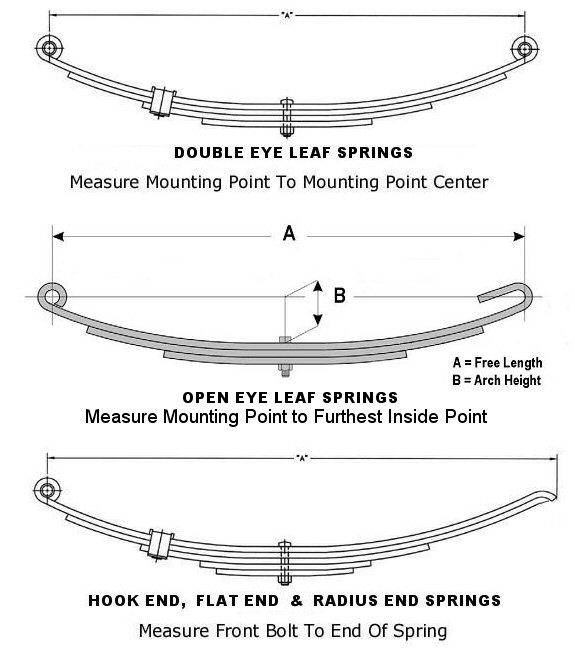
How to Measure a Double-Eye Leaf Spring
Double-eye springs have a closed eye at both ends.
On a typical trailer suspension, one end attaches to a fixed hanger and the opposite end articulates through a shackle or equalizer arrangement.
Also record:
- Spring width
- Number of leaves
- Eye / bushing inside diameter
- Free arch
- Spring rating

PR6 is used in compatible 7,000 lb axle applications as a pair, with each spring rated for 3,500 lb. R&P specifically notes that older springs may measure slightly longer because they can stretch in service.
View PR6 Shop SuspensionSame Length Does Not Mean Same Spring
R&P has an excellent real-world example.
Both the common SW4B and PR6 spring families measure approximately 25.25" eye-to-eye and 1.75" wide.
But they are not the same spring.
| Spring | Free Length | Width | Leaves | Rating | Common Application |
|---|---|---|---|---|---|
| SW4B | 25.25" | 1.75" | 4 | 1,750 lb each | 3,500 lb axle pair |
| PR6 | 25.25" | 1.75" | 6 | 3,500 lb each | 7,000 lb axle pair |
R&P's SW4B listing identifies it as a 4-leaf, 25.25", 1.75"-wide spring rated for 1,750 lb per spring — commonly paired for 3,500 lb axle applications.
View SW4B Spring PairHow Slipper Springs Are Different
A slipper spring does not have a closed eye at both ends.
One end attaches at the spring eye while the opposite end slides or bears against the appropriate hanger or equalizer arrangement.
That means you cannot use the same eye-to-eye measurement method used on double-eye springs.
The Spring Is Only One Part of the Suspension
This is where a simple spring article becomes much more useful.
On a tandem double-eye suspension, spring movement passes through several wear points:
When It Makes More Sense to Rebuild the Suspension
If several wear points are already tired, replacing one spring at a time can become a false economy.
That is why R&P has begun building complete curated suspension-rebuild kits around known spring and equalizer geometries.

This kit is built for compatible tandem 3,500 lb axle suspension layouts using 25.25" double-eye springs. Instead of replacing one visible worn part, it refreshes the major suspension wear points together.
View 3.5K Rebuild Kit Shop Suspension KitsWhat the complete 3.5K kit addresses
- Four 25.25" SW4B springs
- Two 7-3/4" EQ-E1 equalizers
- Eight shackle straps
- Greaseable wet bolts
- Bronze bushings
- Frame hangers
- U-bolts and tie-plate hardware
R&P's own listing calls out the reason: worn shackles, bushings, springs, equalizers, and mounting points can cause sag, loose tracking, uneven tire wear, excessive movement, and poor suspension geometry.
There Is a 7K Version of the Same Idea
The complete 7K tandem kit is built around the heavier PR6 spring family rather than SW4B.

This kit is designed around compatible tandem 7K-style suspension layouts using PR6 double-eye springs, EQ-E1 equalizers, and matching 3" round axle U-bolt hardware.
View 7K Rebuild Kit Shop DIY Suspension KitsMeasure the Equalizer Too
Tandem suspension geometry is affected by the equalizer and shackle dimensions, not only by spring length.
Before ordering a rebuild kit, record:
- Equalizer bottom-hole center-to-center dimension
- Equalizer center-pivot hole size
- Shackle strap hole-center spacing
- Spring width
- Bolt diameter
- Hanger layout
Slipper-Spring Equalizers Are Their Own System
R&P also stocks equalizers specifically for slipper-spring suspensions.
For example, the EQ-12-KIT is designed for 2" wide slipper springs and uses a 12" equalizer with a 7/8" center hole and matching mounting hardware.
View EQ-12-KITWhy Your Old Spring May Measure Longer
A worn double-eye spring may flatten and lengthen as it loses arch.
That can make an original 25.25" spring appear longer when measured after years of service.
R&P's PR6 product page specifically warns that older springs may measure slightly longer due to stretching.
How to Match Spring Capacity
Springs are commonly rated individually.
Two springs support one axle, so a typical capacity relationship looks like:
Or:
That does not mean installing heavier springs automatically increases the trailer's GVWR or axle rating.
Spring rating has to remain compatible with the axle, frame, hangers, tires, brakes, wheels, and complete trailer design.
Seven Spring-Replacement Mistakes to Avoid
What Is Your Trailer Telling You?
Compare spring arch, broken leaves, load distribution, shackle position, equalizer condition, tire size, and frame/hanger condition.
Do not assume the spring alone is responsible. Inspect axle alignment, spring centers, hangers, equalizers, bushings, shackles, wheel bearings, axle condition, and tire inflation.
Inspect the shackle straps, bolt holes, bushings, wet or dry bolts, spring eyes, and equalizer pivots before simply installing new springs.
Identify what overloaded or damaged the spring, inspect the corresponding spring on the opposite side, and inspect surrounding suspension hardware before returning the trailer to service.
Why R&P's Rebuild Kits Use Wet Bolts and Bronze Bushings
Suspension pivots move every time the axle travels.
R&P's complete rebuild kits pair greaseable wet bolts with bronze bushings so those pivot locations can be serviced with lubricant rather than relying only on dry hardware.
Your FA-126A1 equalizer wet-bolt kit follows the same idea: the greaseable bolt is designed to allow periodic lubrication and reduce bushing wear where the application matches.
View FA-126A1 Wet Bolt KitWhen Should Leaf Springs Be Replaced?
Inspect a spring closely if you see:
- Broken or cracked leaves
- Significant loss of arch
- Uneven ride height
- Shifted or separated spring leaves
- Damaged or heavily worn spring eyes
- Severe corrosion or material loss
- Axle or tire interference caused by suspension sag
What Should I Send R&P for Spring Fitment Help?
Send:
- Photo of the complete spring from the side
- Photo of both spring ends
- Center-to-center eye measurement for double-eye springs
- Correct end-to-reference measurement for slipper springs
- Spring width
- Leaf count
- Free arch if practical
- Eye / bushing inside diameter
- Axle rating or axle tag photo
- Photo of the equalizer and shackles
- Equalizer hole-center measurements
- Axle tube diameter
- U-bolt size
Free length gets you started. Width, capacity, spring style, equalizer geometry, shackles, bushings, hangers, and U-bolts determine whether the suspension actually fits and works as a system. When several wear points are already tired, an R&P curated suspension rebuild kit may make more sense than chasing one part at a time.
Shop Leaf Springs & Suspension Shop Suspension Rebuild Kits Call 815-357-3292