

How Does a Trailer Breakaway System Work? Switch, Battery & Wiring Explained
Learn what the breakaway switch and battery actually do, how to test the system, when you only need a J-ELEC switch, and when a complete J-BRTK breakaway kit makes more sense.

Your normal trailer brakes depend on the tow vehicle and brake controller. A breakaway system exists for the moment those are no longer connected.
If the trailer separates from the tow vehicle, a cable pulls the pin from the breakaway switch. That switch connects the trailer's onboard emergency battery to the electric brake circuit so the trailer brakes can apply independently of the truck.
How a Trailer Breakaway System Works
That means the breakaway system depends on four things all being ready at the same time: a charged battery, a working switch, intact wiring, and functioning electric brakes.
The Complete System: R&P J-BRTK
If the trailer does not already have a complete functioning breakaway system — or the existing battery, box, charger and switch are all old enough to justify starting fresh — the complete kit is the logical repair.

J-BRTK provides the core components of an emergency electric-brake breakaway system in one package. The onboard 5Ah battery supplies emergency brake power independently of the tow vehicle.
View J-BRTK Shop Breakaway SystemsWhat comes in J-BRTK?
| Component | Job |
|---|---|
| 5Ah 12V Battery | Supplies emergency power to the trailer brakes after separation. |
| Breakaway Switch | Connects battery power to the brake circuit when the pin is pulled. |
| Pull Cable / Pin | Mechanically activates the switch when the trailer separates. |
| Battery Charger | Maintains the breakaway battery from the trailer's compatible charge circuit. |
| Clamshell Box | Protects the battery and related components during trailer service. |
| Mounting Hardware | Secures the breakaway package to the trailer. |
Breakaway Wiring: Think in Circuits
The breakaway system is easiest to understand when you stop thinking of it as an accessory and start thinking of it as a second brake-power path.

In simplified form:
The breakaway output ultimately joins the same trailer brake circuit that feeds the electric brake magnets.
That is why a breakaway kit cannot compensate for broken brake wiring, failed magnets, bad connections, or non-working brake assemblies farther downstream.
When You Only Need the Switch: J-ELEC
Sometimes the battery and charging system are fine, but the switch housing, pull cable, pin, mounting tab, or switch wiring has been damaged.
In that situation, replacing the entire battery system may be unnecessary.
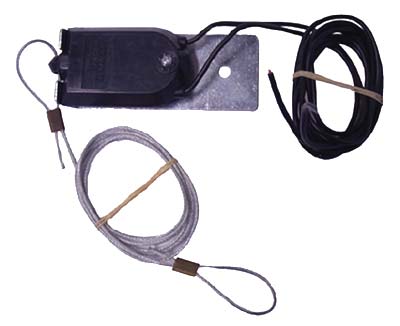
J-ELEC is the switch portion of the breakaway system. One side connects to breakaway battery positive and the other connects into the trailer brake circuit. Pulling the pin closes the emergency braking circuit.
Switch bracket style, lead configuration and cable dimensions should be compared with the existing installation before ordering.
View J-ELEC Shop Breakaway PartsWhere the Breakaway Switch Goes
The switch mounts near the front of the trailer where the pull cable can connect independently to the tow vehicle.

Avoid routing the cable where it can:
- Drag on the road
- Wrap around the jack
- Snag during normal turning
- Pull the switch during ordinary articulation
- Become trapped between coupler components
- Move as one unit with the trailer's safety chains
How to Test a Trailer Breakaway System
A visual inspection alone cannot tell you whether the battery can actually energize the trailer brakes.
Do Not Leave the Breakaway Pin Pulled
Pulling the pin is not the equivalent of setting a parking brake.
With the pin removed, the breakaway system can continuously send battery power to the electric brake magnets.
After testing, reinstall the pin completely and confirm the brakes release. Leaving the switch activated can discharge the breakaway battery and create unnecessary heat in the switch, brake wiring, magnets, and related components.

The Battery Is Not Just a Box on the Tongue
The breakaway battery has one specific job: provide independent power when the tow vehicle can no longer provide normal brake-controller output.
That means a battery that exists physically but cannot hold a usable charge does not provide a functioning emergency braking system.
Inspect:
- Battery age and physical condition
- Terminal corrosion
- Loose connectors
- Charger wiring
- Battery-box damage
- Evidence of water intrusion
- Whether the battery actually remains charged
Brake Controller vs. Breakaway System
| Normal Brake Controller | Breakaway System | |
|---|---|---|
| When Used | Normal towing and braking | Trailer separation emergency |
| Power Source | Tow vehicle electrical system | Onboard trailer breakaway battery |
| Activation | Brake pedal / brake controller | Pull pin removed from switch |
| Brake Circuit | Trailer electric brake magnets | Same trailer electric brake circuit |
| Purpose | Controlled normal braking | Emergency trailer braking after separation |
The Breakaway Kit Still Depends on the Brakes
J-BRTK can provide emergency power, but there still has to be a functioning electric brake system at the wheels.
If the magnets, brake wiring, backing plates, drums, or ground path are defective, the breakaway system may activate electrically without producing normal braking force.

The breakaway battery ultimately energizes the same electric brake magnets used during normal braking. If the wheel-end brakes need service, the emergency system cannot correct that mechanical problem.
View 3,500 lb Brake Pair Shop Trailer BrakesAdding Electric Brakes to an Idler Axle?
This is where the Knowledge Hub pieces connect.
If a compatible idler axle is being converted to electric brakes, the job may involve:
- Electric backing plates
- Hub/drums
- Bearings and seals
- Brake wiring
- 7-way trailer connection
- Breakaway battery and switch
- Tow-vehicle brake controller
R&P's complete 3,500 lb add-brakes kits are built around exactly that concept. For example, the 5-on-5 package includes 10" × 2.25" electric brakes, hub/drums, bearings, wiring, 7-way trailer plug, breakaway battery, charger, case, and emergency pull switch.
Common Breakaway System Failures
J-ELEC or J-BRTK?
| Your Situation | Start With |
|---|---|
| Pull switch or cable is damaged, but battery system is good | J-ELEC replacement switch |
| Trailer has electric brakes but no breakaway equipment | J-BRTK complete system |
| Battery will not hold charge and box/switch are also deteriorated | J-BRTK complete system |
| Pin was left pulled and switch shows heat damage | Inspect entire system; J-ELEC may be required |
| Breakaway activates but brakes remain weak | Diagnose battery, wiring and wheel-end brake system |
| Converting compatible idler axle to electric brakes | Complete brake-conversion system including breakaway equipment |
A 60-Second Breakaway Pre-Trip Check
Where This Fits in the R&P Knowledge Hub
The breakaway system sits directly between several other trailer systems:
- Electric trailer brakes — the wheel-end system the breakaway battery activates
- 7-way trailer wiring — supplies normal brake and charging circuits
- Brake controller — controls normal trailer braking from the tow vehicle
- Brake backing plates and drums — convert electrical input into braking force
- Ground and wiring integrity — required for both normal and emergency brake operation
That is why troubleshooting trailer brakes works best as a system instead of replacing one isolated component at a time.
Need Help Figuring Out What You Have?
Send R&P:
- Photo of the breakaway battery box
- Photo of the switch and cable
- Photo of the wiring entering the box
- Trailer axle count
- Brake size or axle capacity if known
- Whether the brakes work normally through the brake controller
- Whether pulling the breakaway pin activates the brakes
- Any battery voltage or other test readings already taken
J-ELEC handles the switch. J-BRTK supplies the complete battery, charger, box and switch system. But both still depend on healthy wiring and functioning electric brakes at the wheels. Test the complete chain before towing.
Shop J-BRTK Complete Kit Shop J-ELEC Switch All Breakaway Parts Call 815-357-3292